TLDR
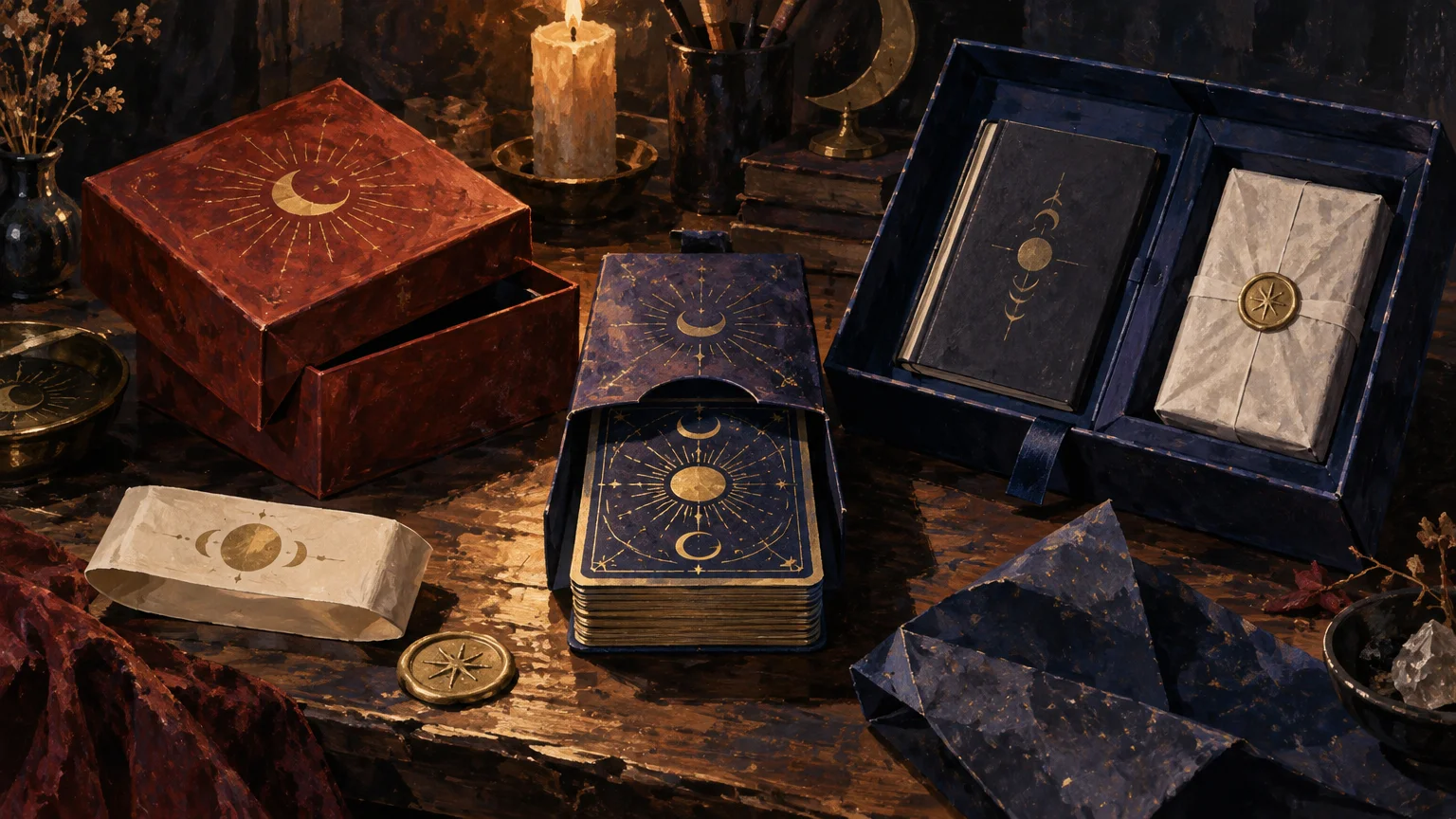
The most practical tarot deck packaging options follow a simple rule: choose the package only after you know exactly what must fit inside it. Use a tuck box for a compact reader’s edition with a folded guide or a few instruction cards. Choose a two-piece rigid box when you want more protection, repeated-use durability, and stronger shelf presentation. Reserve a magnetic book-style box for a substantial guidebook, multiple components, or a deliberately elaborate collector edition. Whatever you choose, approve a physical fit sample before production.
Packaging is not merely a decorative shell. It affects how easily readers remove and return the cards, whether the guidebook stays with the deck, how the product survives shipping, and how much storage space it occupies. A conventional tarot deck contains 78 cards—22 Major Arcana and 56 Minor Arcana—but its finished thickness changes with the stock, finish, extra cards, and manufacturing tolerances.
Tarot has also been repeatedly reinterpreted as a visual tradition, as the Victoria and Albert Museum’s history of tarot illustrates. The box can therefore continue the deck’s symbolic world without becoming so ornate that it frustrates everyday use. The best package makes the deck feel complete while remaining honest about its practical job.
Choose the contents before choosing the box
Begin by making a complete inventory of the edition. Include the finished card size, total card count, cardstock, coating or finish, title and bonus cards, guide material, promotional inserts, certificates, cloths, tokens, and any other object expected to live permanently in the package. A box selected for an unfinished card specification is a box selected too early.
Deck thickness deserves particular attention. Seventy-eight cards printed on one stock will not necessarily occupy the same depth as 78 cards printed on another. A heavy coating, additional cards, or a paper wrap can change the required space. Instead of calculating the cavity from a generic online measurement, ask the printer to confirm it against the actual production specification or a finished deck sample.
The fit should be close enough to stop the contents rattling but not so tight that readers must pinch card edges or shake the package. If a booklet sits above or beside the cards, its binding and page count must be included in the fit calculation. A rigid insert, ribbon lift, or thumb notch also consumes space and changes how the contents are removed.
Tarot deck packaging options compared
| Format | Best use | Main advantage | Main caution | Guide material | Relative budget |
|---|---|---|---|---|---|
| Tuck box | Compact reader’s edition | Lightweight and space-efficient | Corners and flaps receive regular wear | Instruction cards, folded sheet, or very slim leaflet | Lower |
| Two-piece rigid box | Giftable deck for repeated use | More structure and a substantial presentation | Heavier and larger to ship | Slim or medium booklet, depending on cavity design | Medium to higher |
| Magnetic book box | Collector set or deck with substantial guidebook | Holds multiple components in an organized presentation | Magnets, wrapped board, and inserts add complexity | Good for a substantial booklet or book when custom-sized | Higher |
| Drawer box | Organized multi-piece edition | Smooth reveal and separate component areas | Drawer clearance and pull method need careful testing | Suitable when an insert allocates dedicated space | Medium to higher |
| Tin | Travel-oriented hard case | Rigid reusable shell | Can dent, rattle, or constrain custom sizing | Usually cards or a small folded guide | Varies |
| Pouch | Ritual use or soft secondary storage | Flexible, tactile, and easy to carry | Not sufficient shipping protection by itself | Loose cards or a very small guide | Lower to medium |
| Belly band, seal, or shrink wrap | Finishing layer around another package | Adds closure, tamper evidence, or short-run branding | Does not replace a protective box | Depends on the package underneath | Low add-on |
Tuck boxes suit compact reader’s editions
A tuck box is usually the clearest starting point for a first edition intended to be shuffled, carried, and used regularly. Card-packaging suppliers list tuck boxes as a common option for playing cards and small games, and tarot packaging catalogs commonly offer them alongside rigid boxes, tins, pouches, and wraps.
This format works best when the cards are the center of the product and the guidance is concise. A folded sheet, several reference cards, or a QR card linking to a digital guide can remain compact. A thick booklet usually changes the equation: enlarging a tuck box to accommodate a book can create an awkward cavity, weak structure, or excessive empty space around the cards.
Tuck boxes are not disposable by definition, but their folds, corners, and opening flap receive concentrated wear. Keep critical text and delicate symbols away from fold lines. Test whether readers can remove the cards without digging a fingernail into their edges, and avoid using a tight fit as a substitute for an internal support strategy.
Two-piece rigid boxes balance protection and presence
A two-piece box uses a separate lid and base. Supplier listings distinguish this rigid lid-and-base construction from folded tuck packaging. It is a strong choice when a tarot deck is intended to remain on a reading table, become a gift, or withstand frequent opening and closing.
The appeal is not simply that the package looks more expensive. Its structure can protect corners, support a larger printed surface, and make room for a slim booklet. It can also turn the act of opening the deck into a deliberate pause. That moment should still feel effortless: test the lid clearance so it neither falls off nor creates a vacuum-like struggle.
Rigid construction adds weight and volume, which can affect freight, fulfillment materials, and shelf space. It is most worthwhile when its protection and repeat-use experience serve the edition. If the cards will immediately move into a pouch and the original box will be discarded, a simpler format may be the more coherent choice.
Magnetic book boxes need a genuine reason to be larger
A magnetic book box is well suited to a deck paired with a substantial perfect-bound guidebook, a divided interior, or a collector-oriented presentation. It opens like a cover and can create a generous canvas for artwork. Ribbon lifts and fitted inserts may make densely packed contents easier to remove.
As one supplier-specific example, MakePlayingCards lists a tarot-size magnetic book box with a ribbon lift, capacity for up to 80 tarot-size cards, and dimensions of 5.16 × 3.23 × 1.5 inches, or 131 × 82 × 38 mm. Its listing describes 1.5 mm recycled chipboard wrapped in art paper. Those figures describe that product only; they are not universal standards and should not be used to size another printer’s box.
Magnetic boxes introduce additional materials and assembly considerations. Ask where the guidebook sits, whether cards can be removed without bending, and what happens if the booklet page count changes. A beautiful prototype can become impractical if the book floats loose or the ribbon lifts the wrong component.
Let the guidebook determine the package architecture
The guide is often the pivot point between packaging formats. A few instruction cards can remain inside the card stack. A folded leaflet may sit above it. A stitched or stapled booklet needs more depth and may need a separate recess. A perfect-bound guidebook often justifies a larger rigid or magnetic box—or a separate companion volume.
- Instruction cards: keep the same dimensions as the deck unless there is a clear reason not to.
- Folded guide: prototype the folds, closed thickness, and opening sequence before sizing the box.
- Slim booklet: specify trim size, binding, page count, paper, and finished thickness.
- Substantial guidebook: consider a divided insert or a separately sold companion book rather than creating an oversized box for every buyer.
- Launch or thank-you insert: keep it removable so it does not interfere with long-term deck storage.
A formal welcome card, dedication, numbered-edition certificate, or reading prompt can borrow from stationery design. Reviewing printed invitation and stationery formats can help you think through cardstock, hierarchy, and the tactile role of a separate insert. Make the insert earn its place; avoid adding paper merely to make the package feel full.
Wraps, seals, pouches, and tins are supporting choices
A belly band can hold a lid in place and provide a removable space for retail information without covering the permanent box art. Shrink wrap can keep components together before purchase, but it contributes little to the reader’s experience once removed. A paper seal or sticker can create a softer opening ritual, close tissue, brand a plain shipping carton, or carry a care note.
CustomStickers lists matte and gloss packaging-label options as well as labels with a weatherproof laminate, and suggests uses such as tissue seals, shipping-box branding, care notes, and customer extras. Its packaging-sticker information is useful for understanding those finishing applications. A laminate or weather-resistant label should not, however, be treated as proof that the entire package is weatherproof.
Pouches are lovely for travel, ritual handling, or storing a deck after the original package wears out. They do not prevent compression or corner damage in transit and should not replace a protective shipping structure. Tins offer a harder shell, but they need a good internal fit to prevent rattling and surface wear. Both formats are alternatives with distinct tactile characters, not automatic upgrades.
Separate the keepsake box from the shipping package
The deck box is the product package; the mailer is the fulfillment package. Asking one object to perform both jobs often leaves printed corners vulnerable. Even a rigid presentation box may need an outer mailer, movement control, and corner protection during shipping.
Test the packed product as a complete system. Check whether the deck slides inside its presentation box, whether the box moves inside the mailer, and whether pressure transfers to a magnetic flap or lid edge. Production samples should be shipped through the intended route when practical. That test evaluates the actual combination of product, mailer, padding, and handling rather than relying on assumptions about one material.
Design the box as part of the reading experience
The exterior should communicate the deck’s identity at a glance: title, creator or publisher, visual tone, and any essential product information. The rest depends on the format. A tuck box needs strong front-panel recognition. A book-style box can use its spine. A two-piece box may create a reveal by carrying one symbol across the lid and another inside the base.
Keep typography readable at physical size. Foil, dark ink, delicate serif type, and low-contrast color combinations should be proofed on the intended stock rather than judged only on screen. If you are still preparing the card files, the same discipline applies to the artwork itself; see how to prepare tarot artwork without losing detail before locking the packaging palette.
I would ask one creative question before approving the design: what should the reader feel when opening this deck? A shadow-rich introspective deck might use a restrained exterior with a luminous interior. A botanical deck might continue its growth motif around the box edges. A practical learning deck may benefit more from clear labeling and quick-reference information than from an elaborate unboxing sequence.
Use sustainability language with precision
Ask the manufacturer for the actual board composition, recycled content, paper wrap, coating, lamination, adhesives, magnets, inserts, and relevant certifications. Avoid calling an entire package recyclable because its largest component is paperboard. Mixed materials and local collection systems can change the answer.
The Forest Stewardship Council’s packaging guidance also distinguishes broad paper or cardboard recyclability language from substantiated responsible-sourcing claims. Chain-of-custody certification matters when making an FSC-certified material claim. Request project-specific documentation and approve the exact environmental wording rather than borrowing a claim from a different product.
What to include in a packaging quote request
- Finished card width, height, corner radius, and orientation
- Total number of cards, including title, reference, bonus, and replacement cards
- Cardstock, core, coating, finish, and expected finished deck thickness
- Guidebook trim size, binding, paper, page count, and finished thickness
- Required internal cavity dimensions and acceptable movement
- Insert type, finger notches, ribbon lifts, dividers, or component wells
- Box structure, board thickness, paper wrap, and closure method
- Printing, foil, embossing, spot finishes, lamination, and edge treatments
- Assembly, component packing, wrapping, seals, and barcode placement
- Prototype, digital proof, production sample, and fit-approval process
- Order quantity, overage policy, fulfillment destination, and freight terms
- Shipping-test requirements for the fully packed retail product
Keep the package specification synchronized with the cards. If the stock, finish, or bonus-card count changes, ask whether the cavity must change as well. For a broader view of how cardstock and finish shape the physical deck, read how to create a tarot deck that looks and feels right.
Three reliable packaging pathways
For a reader’s edition, I would begin with a fitted tuck box, 78 cards, any essential title or reference cards, and a folded guide. It is compact, straightforward, and keeps attention on the deck.
For a premium retail edition, I would choose a two-piece rigid box with a tested card well and a slim booklet. This path earns its larger footprint through better protection, repeat use, and a more substantial presentation.
For a collector edition, I would consider a magnetic book box only when a substantial guidebook, special insert, or multi-component concept genuinely needs it. The extra structure should organize the contents and deepen the symbolic presentation, not merely announce that the edition is expensive.
Finalize the cards and guide first, request a structural prototype or blank fit sample, and handle it as a reader would. Remove the deck, shuffle it, return every component, close the box, and pack it for shipping. That simple rehearsal will tell you more than a glamorous rendering—and it is the most dependable next step toward packaging that feels beautiful because it works.