TLDR
The simplest answer to how to read tarot for yourself is this: write one open-ended question, choose a one- or three-card spread, draw only once, and interpret the cards before reaching for clarifiers. Begin with the artwork, consult the guidebook, record your interpretation, and finish with one grounded action. If you catch yourself asking the same question in different words, stop. You are probably seeking reassurance rather than new information.
Self-reading is not about becoming perfectly objective. It is about creating enough structure to notice when hope, fear, or impatience is speaking louder than the cards. You can absolutely read tarot for yourself, but the reading becomes more useful when you decide on the question, spread, and stopping point before you shuffle.
Why reading for yourself can feel difficult
When you read for someone else, you have some distance from the outcome. When you read for yourself, you may already know which answer you want. A promising card can become a guarantee; an uncomfortable card can inspire three clarifiers, a reshuffle, and a newly worded version of the original question.
That does not mean you lack intuition. It means you are emotionally involved. A good self-reading method accounts for that involvement instead of pretending it is absent.
Before drawing, name your current state in one sentence: “I feel hopeful about this,” “I am afraid of losing this opportunity,” or “I want permission to do what I have already decided.” This small act separates your existing feelings from the interpretation that follows.
Start with one question that invites reflection
Questions that demand certainty often produce strained readings. “Will this definitely happen?” encourages prediction and repeated checking. A reflective question gives the cards a more practical role: illuminating a pattern, tension, choice, or next step.
A reliable formula is: “What can I understand, notice, or do about _?” Choose one of those verbs and fill in the actual subject. Keep the question visible while you read so that every card is interpreted in relation to it.
| Instead of asking | Try asking |
|---|---|
| Will I get the job? | What can I do to approach this opportunity well? |
| Does this person love me? | What should I understand about the dynamic between us? |
| Is this change going to work out? | What will help me move through this change constructively? |
| Will everything be okay? | What needs my attention, and what can I influence now? |
| Should I leave? | What am I not yet acknowledging about staying or leaving? |
The revised questions do not remove uncertainty, but they return some agency to you. They also make it harder to disguise the same question five different ways. If the underlying subject and desired answer have not changed, it is still the same question.
Choose a spread before you shuffle
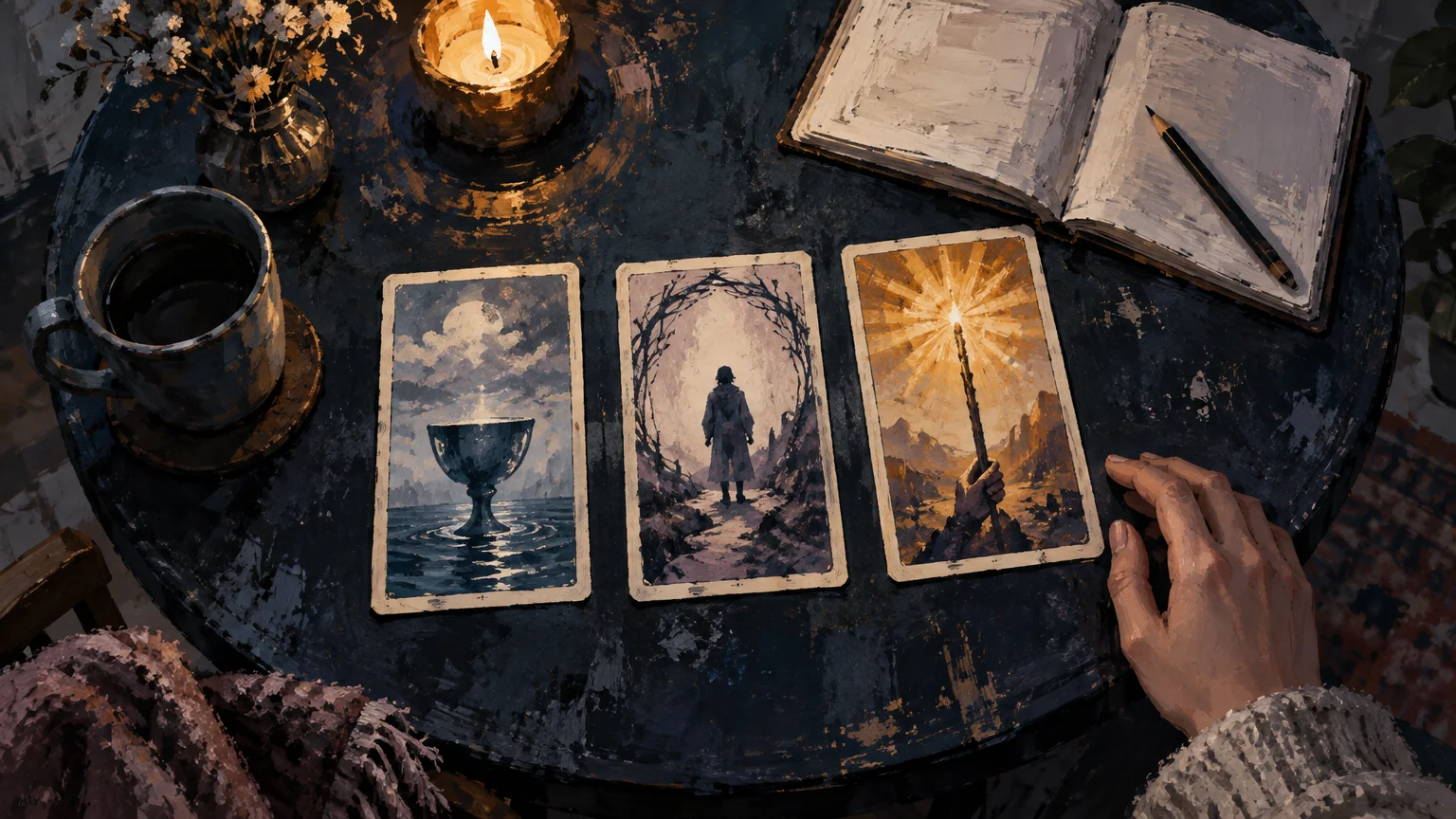
More cards do not automatically create more clarity. For beginners—and for emotionally charged subjects—I would choose one card or a fixed three-card spread. The limit gives each image room to speak and makes it easier to see when you are pulling beyond the useful end of the reading.
The one-card check-in
Ask, “What should I pay attention to today?” Draw one card and spend at least two minutes observing it before consulting a meaning. This is an excellent daily practice because it asks for attention rather than a forecast.
The three-card clarity spread
- Situation: What is present or important here?
- Tension: What complicates, restricts, or challenges the situation?
- Constructive next step: What response is available to me?
Write these positions down before drawing. Position is part of meaning: a card appearing as the tension should not be read in exactly the same way as that card appearing as the next step.
Use the See, Say, Source, Step method
You do not need to memorize an entire deck before conducting a useful self-reading. Use four passes through each card.
- See: List visible details without interpreting them. Notice posture, direction of gaze, color, weather, repeated shapes, empty space, and the relationship between figures.
- Say: Describe your immediate response in plain language. “This figure looks trapped,” or “The open horizon feels inviting,” is more useful than trying to sound mystical.
- Source: Read the deck’s guidebook or a trusted reference. Note what it adds, confirms, or complicates. Using a guidebook is study, not cheating.
- Step: Translate the interpretation into one proportionate action, boundary, conversation, or observation.
Keep observation and interpretation separate at first. “Three birds appear above the figure” is an observation. “The birds represent freedom” is an interpretation. That distinction helps you recognize what comes from the artwork, what comes from an established tradition, and what comes from your personal associations.
Deck context matters. A Rider-Waite-Smith-style deck commonly contains 78 cards divided into 22 Major Arcana and 56 Minor Arcana, with Pamela Colman Smith’s influential artwork first published in 1909. Other decks may revise the names, symbols, structure, or visual emphasis. Let the guidebook for the deck in your hands inform the reading rather than forcing every image into a single inherited meaning.
A worked three-card self-reading
Suppose the question is, “What can I understand and do about my creative stagnation?” The cards are Four of Cups for the situation, Eight of Swords for the tension, and Page of Wands for the constructive next step.
Situation: Four of Cups
In a familiar Rider-Waite-Smith image, the seated figure appears disengaged from the cups nearby. In this position, a possible interpretation is that creative options exist but do not currently feel alive or satisfying. That is not the same as predicting permanent failure. It describes the present relationship to the work.
Tension: Eight of Swords
The bound figure and surrounding swords may suggest restriction, narrowed perception, or fear of making the wrong move. As the tension, the card could point to rigid internal rules: the work must be original, impressive, profitable, or complete before it is allowed to be playful.
Constructive next step: Page of Wands
The Page can be read as experimental, curious energy. A grounded next step might be: make one rough sketch in an unfamiliar medium, with no intention of showing or selling it. The action is small enough to complete and directly addresses the restriction suggested by the second card.
This is an illustrative reading, not a fixed definition or prediction. A different deck might depict these cards differently, and the interpretation would change with the question, position, surrounding cards, and reader’s circumstances.
Clarifiers need boundaries
A clarification card should clarify a defined part of the reading, not replace a card you dislike. Before pulling one, complete this sentence: “I need clarification about _.” If you cannot name the ambiguity precisely, return to the original imagery or guidebook instead.
Limit yourself to one clarification card for the entire spread. After that, close the reading. If the message remains unclear, write down the uncertainty and revisit your notes later rather than building a ten-card maze around a three-card question.
You do not have to read reversals
Beginners can keep every card upright. Reversals are an established option, not an entrance requirement. A. E. Waite’s 1910 The Pictorial Key to the Tarot records upright and reversed meanings, showing their place in an influential reading tradition. The Pictorial Key to the Tarot can be consulted as a historical reference, but its method does not obligate every modern reader to use reversals.
If you do use them, choose your approach before shuffling. You might read a reversed card as blocked, internalized, excessive, diminished, or redirected energy. Use one consistent framework for the reading. An inconvenient reversal is not a reason to turn the card upright, reshuffle, or begin again.
Ritual is optional; attention is not
Tarot has not always occupied the same cultural role. It developed as a trick-taking card game in 15th-century northern Italy, while associations with fortune-telling and occultism arose later and gained currency in the 19th century, according to the Metropolitan Museum of Art’s history of tarot.
That long, changing history leaves room for different approaches. You may light a candle, shuffle in silence, pray, meditate, or simply clear enough table space for three cards and a notebook. The useful question is not whether your ritual looks suitably mystical. It is whether the setting helps you pay attention and respond honestly.
Know when to stop pulling cards
End or postpone the reading when any of these are true:
- You are repeating the question because you dislike the first answer.
- You are changing spreads while continuing to seek the same reassurance.
- Each new card increases panic rather than understanding.
- You are too tired, angry, frightened, or overwhelmed to interpret proportionately.
- You are treating the cards as a substitute for qualified medical, legal, financial, mental-health, or emergency support.
- You already have a reasonable next step but keep pulling because action feels harder than interpretation.
Closing the deck is part of reading well. If repeated checking has become a pattern, set a waiting period for that subject. Your appropriate rhythm may be daily, weekly, or only when something meaningfully changes; how often you read tarot matters less than whether each reading has a distinct purpose.
Keep a simple tarot journal
A written record helps you distinguish the original reading from the story you remember later. Copy this template into a notebook:
- Date and deck
- Question
- Spread and card positions
- Cards drawn
- First visual impressions
- Guidebook or reference notes
- My interpretation
- One grounded next step
- What I will revisit, and when
Do not judge a reading only by whether an event later resembles it. Also ask whether the reading helped you name a feeling, notice a pattern, make a considered choice, or approach a conversation more clearly. Tarot’s value in a self-reading can lie in the quality of reflection rather than certainty about the future.
A seven-day way to learn how to read tarot for yourself
For the next seven days, use only a one-card check-in. Ask the same broad question—“What should I pay attention to today?”—but treat each day as a new context. Spend two minutes with the image, write three observations, consult the guidebook, and choose one modest action or point of attention.
At the end of the week, review the entries together. Look for recurring colors, postures, suits, emotional reactions, and assumptions. If a card repeats, note what remained unresolved or newly relevant; do not assume repetition guarantees a particular external event.
After seven days, try the three-card clarity spread on one genuine but manageable question. Decide in advance that three cards are enough. The aim is not to squeeze certainty from the deck. It is to see your situation more honestly, hear what the imagery evokes, and leave the table with one next step you can actually take.
References
- <visual_element id="e1">
- U.S. Games Systems, Inc. > Pamela Colman Smith > Rider-Waite Tarot Deck
- The Pictorial Key to the Tarot: Being Fragments of a Secret Tradition Under … – Arthur Edward Waite – Google Books
- The Pictorial Key to the Tarot – Arthur Edward Waite – Google Books
- Before Fortune-Telling: The History and Structure of Tarot Cards – The Metropolitan Museum of Art