
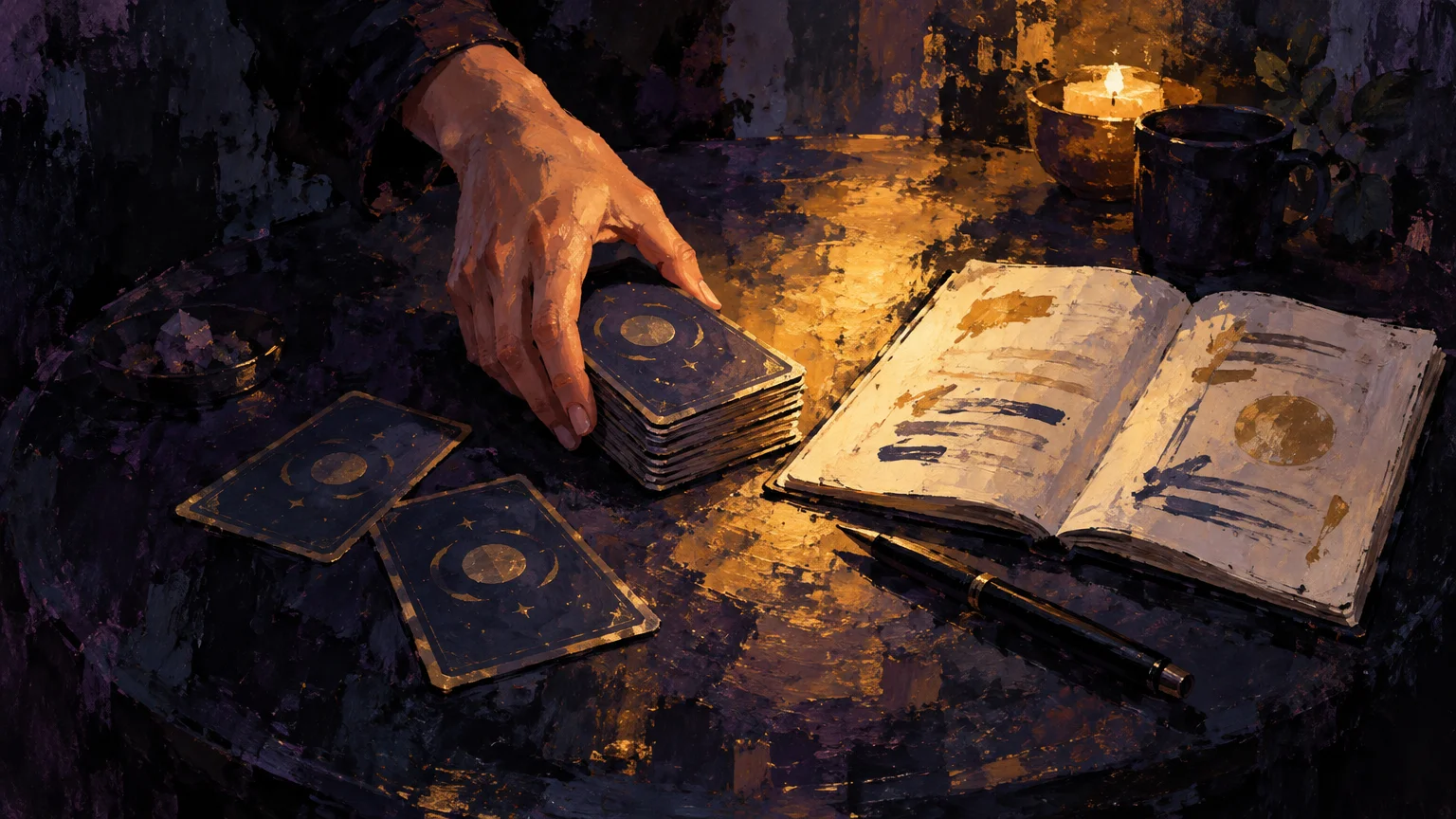
The most useful way to end a tarot reading is to return to your original question, summarize the spread in one or two sentences, and name one realistic next step if the reading calls for action. Then record the essentials, gather the cards, and let the reading be finished.
That last part matters. A reading can lose its clarity when we keep drawing cards because the first answer felt complicated, inconvenient, or insufficiently reassuring. Closing well gives the symbols somewhere to settle. It turns a table full of separate images into a thought you can carry into ordinary life.
Closing a reading is a process, not a required ritual
There is no single universal ceremony for closing tarot. Joan Bunning’s question-reading procedure treats the details as adaptable while ending with interpretation, a summary, a record of the reading, and clearing the cards. Shuffling again, speaking a phrase, sitting in silence, or taking a deliberate breath can be meaningful, but none is compulsory.
Nor does history give us one ancient closing formula that every reader must follow. Tarot began as a Renaissance card game, with its divinatory use developing later, particularly from the late eighteenth century onward, as the Victoria and Albert Museum’s history of tarot explains. A modern personal ritual can be beautiful without pretending it is universal or ancient.
Begin by returning to the question
Before touching the deck, read your original question again. This creates a frame around the interpretation and helps you notice whether the reading actually addressed what you asked.
Questions can drift during a reading. “What do I need to understand about this conflict?” quietly becomes “Will the other person apologize?” Then it becomes “When will they apologize?” By the end, the reader is answering a different and much narrower question than the one that opened the spread.
If you tend to chase reassurance in self-readings, use the same discipline described in reading tarot for yourself without repeating the question: keep the original wording visible and resist asking it again in several disguises.
Write a one- or two-sentence synthesis
A closing summary should not retell every card. It should identify the pattern connecting them. Look for the central tension, what remains within your agency, and the direction suggested by the spread. A useful sentence structure is:
“This reading suggests that the central issue is . My role now is to , while remaining aware of .”
The word “suggests” leaves room for judgment and changing circumstances. It also keeps the cards in a reflective role rather than turning them into an order you must obey.
For example, imagine a three-card reading about creative burnout. The first card points toward overextension, the second toward neglected rest, and the third toward a smaller but sustainable rhythm. A useful summary might be: “This reading suggests that my creative block is partly exhaustion rather than lack of talent. My next step is to reduce the size of the project and protect regular time for rest.”
That conclusion is more usable than three isolated card meanings. It also gives you something specific to revisit later.
Use a three-part closure when the spread feels scattered
If you understand each card but cannot see the whole reading, do not immediately draw another clarifier. Move through these three closing prompts instead:
| Closing prompt | What to identify | Useful wording |
|---|---|---|
| What is the central tension? | The conflict, pattern, or choice connecting the cards | “The heart of this reading is…” |
| What is within my agency? | A response, boundary, conversation, or shift in attention | “What I can influence is…” |
| What should I carry forward? | A proportionate action or a theme for reflection | “For now, I will…” |
You can also build a compact three-card spread around those positions: central tension, personal agency, and next movement. It works especially well when a larger spread has produced plenty of detail but no memorable conclusion.
Choose an action only when the reading needs one
A practical question often benefits from a practical ending. If you asked how to prepare for a difficult conversation, the next step might be writing down your boundary or choosing a calm time to speak. Keep the action small enough to complete and closely connected to the reading.
An open reading is different. If you asked what energy deserves your attention this month, you may not need to manufacture a task. The closing summary can name a theme to notice, a feeling to make room for, or a question to carry into your journal. Not every card spread must become homework.
Record the reading before clearing the cards
Before you gather the spread, preserve the details most likely to disappear. Record the date, exact question, cards, spread positions, reversals if you use them, and your immediate interpretation. A quick photograph can preserve the layout, but add at least a sentence of context; an image alone may not remind you what felt important at the time.
End the entry with your final synthesis and any next step. Later, you can compare your first interpretation with what unfolded without rewriting the reading to fit the outcome.
Give the reading a physical endpoint
Once the interpretation is recorded, gather the cards deliberately. You can return them directly to their box or wrap, or shuffle first if that helps the deck feel reset. Tidying the cloth, moving your journal aside, or putting away a candle can reinforce that the reading period has ended. These are practical choices, not spiritual requirements.
If you enjoy a spoken closing, keep it simple: “I have taken what I need from this reading for now.” Gratitude, silence, or one steady breath can do the same work. The purpose is not to perform the perfect ritual. It is to acknowledge that reflection is complete for the moment.
Close readings for other people with care
When reading for another person, summarize without taking control of their decision. Confirm what they found useful, distinguish possibilities from certainties, and leave room for their own judgment. The International Tarot Foundation’s code of ethics emphasizes confidentiality, respect, autonomy, and avoiding fear-based certainty. It also advises readers to recognize the limits of their competence and refer people to qualified professionals when specialist medical, legal, financial, or psychological help is appropriate.
A considerate closing question is: “What feels most useful for you to take from this reading?” That gives the querent a voice in the summary instead of making the reader the final authority over their life.
Know when not to draw another card
For your next reading, practice a fixed ending: reread the question, write two sentences of synthesis, choose one proportionate action if appropriate, record the spread, and put the deck away. A good close does not seal the future. It gives the reading a clear shape—and gives you enough quiet to hear what it has already said.