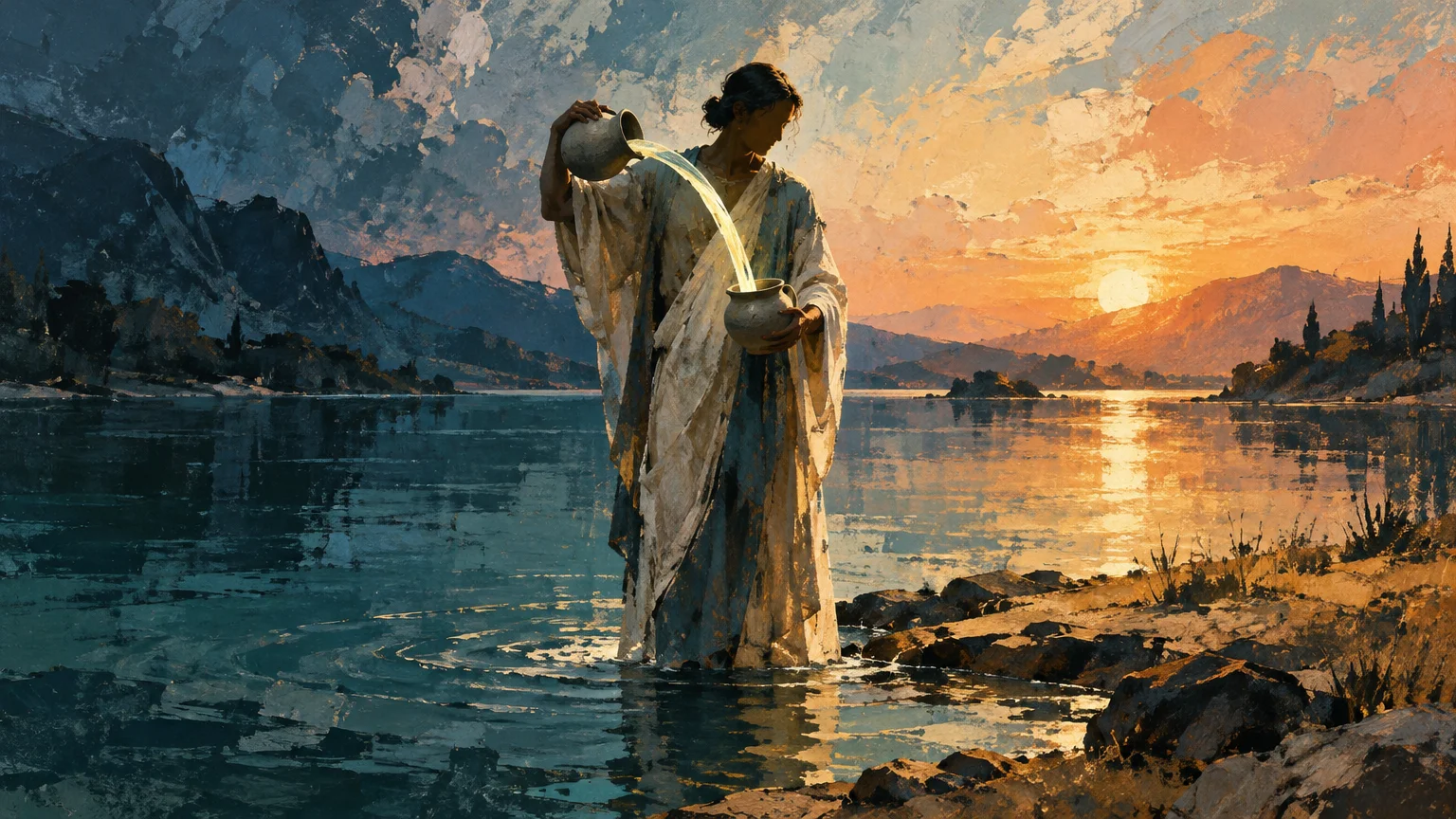
Temperance represents integration, patience, moderation, and right proportion. It appears when different needs, feelings, people, or resources must be brought into a workable relationship—not by flattening their differences, but by adjusting the mixture until it can hold.
This is not a card of passive balance or endless waiting. The figure pouring between vessels is doing careful work. Temperance asks you to observe, combine, test, and refine. Its practical question is often simple: What adjustment would make this situation more sustainable?
The core meaning of Temperance
Temperance is Major Arcana XIV. Its roots reach back well before modern divination: the card appears among the trumps of the fifteenth-century Visconti-Sforza Tarot. Tarot began as a trick-taking card game in northern Italy, while its strong association with occultism and fortune-telling developed later. The Metropolitan Museum of Art’s history of tarot offers useful context for that evolution.
In Renaissance art, Temperance was one of the four cardinal virtues. Artists commonly represented it through the mixing of liquids, such as cooling hot water or diluting wine with water. The image expressed moderation as right measure: knowing how much, how quickly, and in what proportion. The Uffizi Galleries’ account of the virtue shows how deeply this mixing motif belongs to the card’s visual ancestry.
That history gives Temperance more texture than the word “balance” alone can carry. Balance may sound static, as though success means keeping two equal weights perfectly still. Temperance is active calibration. One ingredient may need more room than another. The correct proportion may also change as the situation develops.
How the imagery shapes a reading
In the Rider–Waite–Smith card, a winged figure pours between two chalices while standing with one foot on earth and one in water. A path rises toward distant heights and a crown of light. A. E. Waite described the figure as neither male nor female and interpreted the card through the harmonizing of psychic and material natures. His upright terms included moderation, economy, management, accommodation, and frugality.
The earth-and-water stance suggests contact between different modes of experience: the practical and intuitive, embodied and reflective, visible and unseen. The vessels make that contact purposeful. Something is being transferred, but it is not dumped all at once. The card respects process.
Pamela Colman Smith designed the imagery of the deck commonly called Rider–Waite–Smith, with Arthur Edward Waite as publisher; it was first printed in 1910, according to the Victoria and Albert Museum’s tarot history. Knowing the artist matters because Temperance communicates through composition as much as keywords: a steady posture, repeated vessels, flowing liquid, and a landscape that draws the eye patiently forward.
Three questions that unlock Temperance
When Temperance appears, I would begin with three questions. They turn an abstract message about harmony into something a reader can examine and act upon.
- What is being mixed? Identify the needs, responsibilities, emotions, skills, or people that must coexist.
- What is out of proportion? Look for excess, neglect, incompatible timing, or one concern consuming all available energy.
- What pace would allow the situation to stabilize? Choose a rhythm that permits observation and adjustment instead of demanding an immediate final result.
These questions arise from the historical virtue of moderation and the recurring vessel-pouring image; they are an interpretive framework, not a universal rule for every deck or tarot tradition.
Temperance upright in different reading contexts
| Context | Likely emphasis | Useful question |
|---|---|---|
| Relationships | Patience, communication, mutual adjustment, and blending different needs without erasing individuality | What compromise supports both people rather than asking one person to disappear? |
| Work and creativity | Combining skills, editing excess, coordinating priorities, and improving through iteration | What small revision would make the whole project more coherent? |
| Inner life | Bringing emotional, bodily, material, and reflective needs into contact | Which part of life has been excluded from the conversation? |
| Decision-making | Testing a proportionate response rather than forcing an extreme or premature choice | Can this decision be approached as an experiment instead of an ultimatum? |
| Timing | Gradual progress, recovery, or integration that cannot be rushed without becoming unstable | What needs time to settle before the next move? |
In a relationship reading, Temperance does not automatically promise reconciliation. It asks whether the people involved can make meaningful adjustments while preserving honesty and boundaries. In work, it may favor careful coordination over a dramatic pivot. Waite’s language of management and accommodation makes this card especially relevant when several priorities must share limited time or resources.
For creative practice, Temperance is the patient editor. It may tell you to soften a crowded composition, combine two partial ideas, or let contrasting visual languages speak to each other. Integration is not the same as adding everything. Often it means removing whatever prevents the remaining elements from forming a clear whole.
What reversed Temperance can mean
Reversed Temperance commonly points toward imbalance, excess, impatience, turbulence, or poor integration. The ingredients may be individually sound but badly combined. A rushed schedule, mismatched expectations, or repeated overcorrection can keep the situation unstable.
Reversed meanings are not standardized, however. Waite’s own list included disunion, unfortunate combinations, and competing interests, along with associations involving religious institutions or clergy. Modern interpretations centered on miscalibration are useful, but they are not the card’s only historical reversed meanings.
Instead of treating the reversal as a command to “find balance,” identify the failed mixture. Are you combining commitments that cannot coexist in their current form? Are you moving between extremes instead of making measured corrections? Has patience become avoidance? The reversal asks for diagnosis before another adjustment.
Temperance compared with other cards of pause and alignment
Temperance can resemble other Major Arcana cards while asking for a distinct response. The Hanged Man pauses to release control and see differently; Temperance continues working through gradual adjustment. The Lovers can emphasize values, relationship, and consequential choice; Temperance asks how the chosen elements will function together over time.
This distinction is helpful when several reflective cards appear in one spread. A pause may be necessary, but Temperance usually wants the pause to serve integration. It is less “do nothing” than “do not force the final form before the parts have learned how to meet.”
Designing a Temperance card without copying it
For deck creators, the pouring motif predates the Rider–Waite–Smith deck by centuries. You can change the figure, setting, gender presentation, vessels, palette, and materials while retaining the recognizable action of controlled transfer between distinct containers or states.
First decide which symbols are inherited and which are yours. Vessels, pouring, moderation, and right measure belong to the card’s established visual lineage. A particular animal, flower, color system, celestial correspondence, or personal mythology may be a new layer introduced by your deck. Keeping that distinction clear helps the artwork feel original without making its central action unreadable.
A practical way to work with Temperance
Place the card beside your question and name the two or three elements being combined. Then write down the current proportion and one modest adjustment. If the reading concerns work, that might mean reducing the scope of one task rather than abandoning the project. In a relationship, it might mean changing the rhythm of communication rather than demanding instant certainty.
End with one action that can be observed and revised. Temperance favors a measured next step: adjust the mixture, give it time to respond, and notice what changes. If you are closing a larger spread, summarize the reading with a grounded next step rather than turning the card into a vague instruction to be patient.
The deepest message of Temperance is not that every tension can be made equal. It is that thoughtful relationship is a craft. Choose the elements carefully, respect their differences, and keep adjusting until the combination becomes livable.
References
- Before Fortune-Telling: The History and Structure of Tarot Cards – The Metropolitan Museum of Art
- The Temperance by Piero del Pollaiolo | Uffizi Galleries
- XIV. Temperance – The Pictorial Key to the Tarot
- A history of tarot cards · V&A
- Temperance Meaning – Major Arcana Tarot Card Meanings – Labyrinthos
- The Pictorial Key to the Tarot by A.E. Waite (1910)