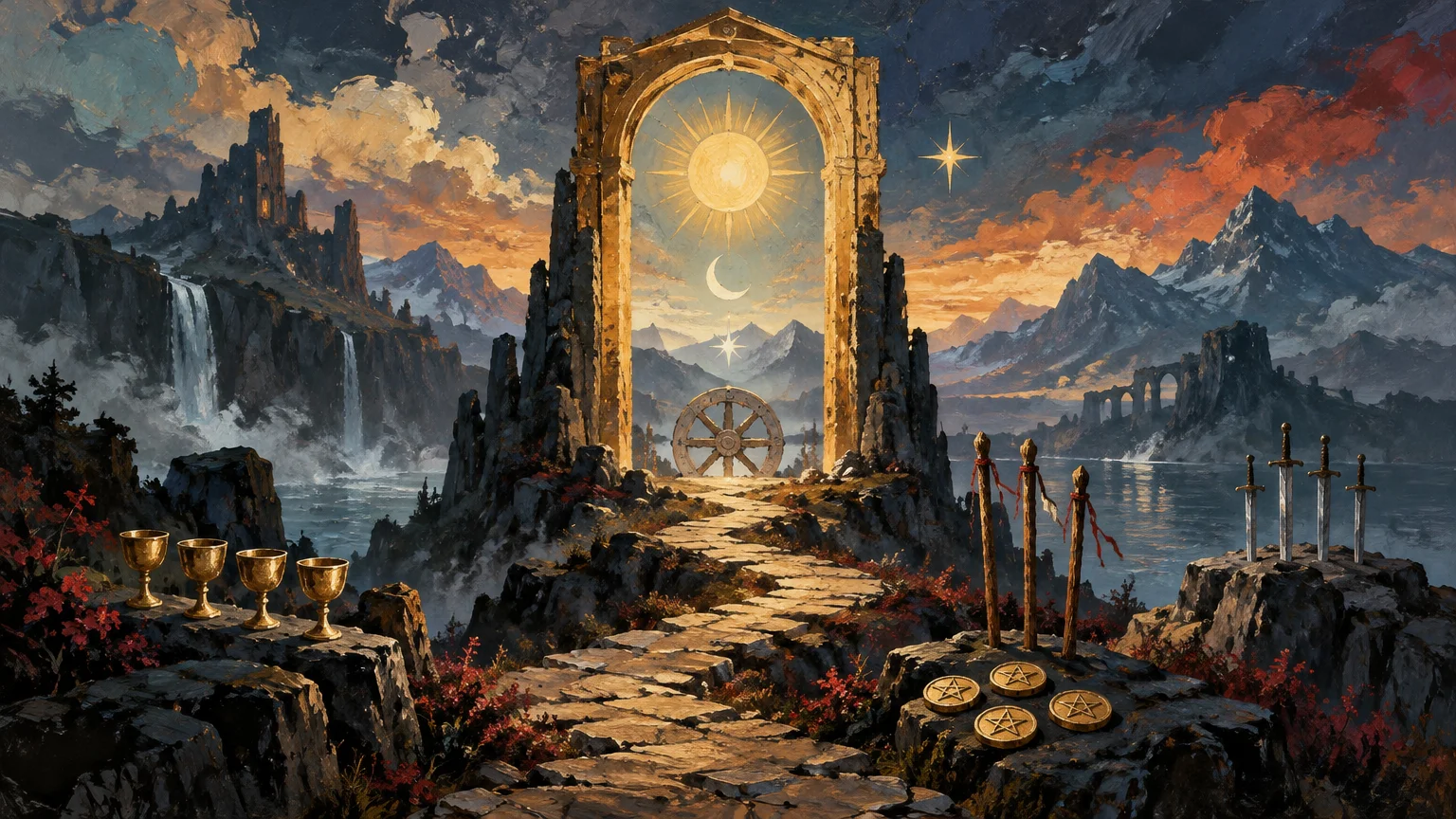
The simplest difference between the Major and Minor Arcana is one of scale. Major Arcana cards tend to describe the larger theme, turning point, or developmental pressure in a reading. Minor Arcana cards bring that theme into daily life through emotions, decisions, relationships, work, conflict, resources, and action.
They are not two separate systems competing for attention. Think of the Major Arcana as the shape of the story and the Minor Arcana as the scenes through which that story becomes real. A Major can tell you what kind of chapter you are in; the Minors help explain what is happening on the page today.
Major Arcana vs Minor Arcana at a glance
| Feature | Major Arcana | Minor Arcana |
|---|---|---|
| Number of cards | 22 | 56 |
| Traditional structure | The Fool and 21 numbered cards | Four suits with 14 cards each |
| Common reading role | Broad themes, major transitions, archetypal experiences | Daily circumstances, reactions, choices, people, and practical details |
| Internal divisions | A sequence of individually named images | Wands, Cups, Swords, and Pentacles or Coins |
| Types of cards | Named cards such as The Magician, Temperance, and The Tower | Ace through Ten plus Page, Knight, Queen, and King |
| Useful question | What larger process is unfolding? | Where and how is it unfolding? |
A conventional tarot deck contains 78 cards: 22 Major Arcana and 56 Minor Arcana. Each Minor suit contains ten numbered cards and four court cards. The Minor Arcana therefore makes up more than 70% of the deck, which is a good reminder that “minor” does not mean trivial.
What the Major Arcana contributes
The Major Arcana includes cards such as The Fool, The High Priestess, The Lovers, Death, The Star, and The World. In modern divinatory practice, these cards commonly point toward significant transitions, enduring lessons, powerful realizations, or forces that seem larger than the immediate details of a situation.
A Major card asks you to pause and look at the deeper pattern. Temperance, for example, may direct attention toward integration, patience, and right proportion rather than one isolated event. That larger pattern can then be explored through the card’s imagery and the surrounding cards; our guide to the meaning of Temperance shows how one Major can unfold across several practical contexts.
This does not mean every Major predicts a dramatic, destiny-altering event. The Hermit can appear during an ordinary week because solitude or inner guidance matters within that week. The Chariot can describe the focused handling of a modest project. The card’s symbolic scale may be large even when its outward expression is quiet.
What the Minor Arcana contributes
The Minor Arcana gives a reading texture and location. Its four suits identify broad areas of experience, while the number or court rank helps shape the action within that area.
- Wands commonly concern action, creative energy, ambition, and initiative.
- Cups commonly concern feelings, relationships, imagination, and receptivity.
- Swords commonly concern thought, communication, tension, truth, and conflict.
- Pentacles, also called Coins in some decks, commonly concern work, resources, the body, routines, and material conditions.
These suit associations belong to established modern Western tarot practice rather than the rules of tarot’s original card game. They are best treated as a useful symbolic framework, not a law that prevents a card from carrying additional shades of meaning.
Numbers and court ranks add another layer. A Three suggests a different stage than a Ten, even when both belong to the same suit. Court cards can represent people, personality facets, roles, or ways of approaching a situation. Context determines which possibility is most useful.
How to combine Major and Minor cards
- Name the Major card’s central theme in one short phrase.
- Identify the suit of the accompanying Minor card.
- Notice the Minor card’s number, rank, action, and emotional tone.
- Connect both cards to the question rather than interpreting them in isolation.
- Summarize the relationship in one clear sentence.
Suppose a reading contains The Hermit and the Eight of Pentacles. The Hermit may introduce a broad theme of reflection, independent inquiry, or learning through focused solitude. Pentacles places that theme in a practical domain, while the Eight can suggest repeated effort and skill-building. Together, the cards might say: “This period of withdrawal is helping you develop a craft through patient practice.”
If The Hermit instead appeared with the Two of Cups, the larger theme would remain reflective, but its expression would move toward connection and emotional exchange. You might explore whether a relationship needs quieter honesty, deliberate space, or a meeting between two people who have each done some inner work.
This broad-theme-plus-specific-context method is a contemporary interpretive workflow, not a universal historical rule. Its value is practical: it keeps the Major from becoming vague and prevents the Minor from becoming a list of disconnected keywords.
What a Major-heavy or Minor-heavy spread can suggest
When several Major Arcana cards appear, the reading may feel concentrated around larger patterns, transitions, or questions of identity and direction. Do not automatically declare that fate has seized the steering wheel. Instead, ask why the situation feels especially meaningful and which repeated themes deserve attention.
A spread dominated by Minor Arcana often invites closer attention to manageable circumstances: conversations, habits, schedules, emotional responses, money, or work. That does not make the reading less profound. Daily choices are where many larger transformations acquire a body.
If you are reading for yourself, write down your first interpretation before drawing clarifiers. This helps you avoid diluting a clear message by repeatedly asking for a different one. The same discipline is useful when following a structured approach to reading tarot for yourself without repeating the question.
The historical distinction came later
Tarot began in northern Italy during the fifteenth century as a trick-taking game. Its pack combined four regular suits with the Fool and 21 trumps. The Metropolitan Museum of Art’s history of tarot describes early references from the 1440s and 1450s and explains this original structure.
The labels “Major Arcana” and “Minor Arcana” are younger than the cards themselves. The Victoria and Albert Museum’s history of tarot cards attributes the terminology to nineteenth-century French occultist Éliphas Lévi. Tarot’s powerful association with divination likewise developed after its game-playing origins.
Deck imagery evolved as well. Earlier numbered suit cards often displayed arranged suit symbols, much like traditional playing-card pips. The 1909 Rider-Waite-Smith deck gave the Minor Arcana fully illustrated scenes, with Pamela Colman Smith exercising broad creative latitude over those cards. That visual approach deeply influenced later deck design.
For readers, scenic Minors can make emotions and actions immediately visible. Pip-based decks ask for greater fluency with suit and number. Neither approach is inherently more authentic; they simply create different reading experiences.
Read the deck as one connected language
The Major Arcana tells you where the symbolic gravity lies. The Minor Arcana shows where that gravity touches the ground. Read the Major for the larger movement, the suit for the life domain, and the number or court rank for the situation’s particular shape.
For your next reading, draw one Major and one Minor card deliberately. Give the Major a short thematic phrase, give the Minor a concrete setting or action, and join them in a single sentence. That small exercise teaches the essential relationship: the Majors reveal the pattern, while the Minors show how you are living it.
Frequently Asked Questions
What is the main difference between the Major and Minor Arcana?
The Major Arcana usually expresses the larger theme, transition, or developmental pattern. The Minor Arcana shows how that pattern appears through daily choices, relationships, emotions, work, conflict, and resources.
Does “Minor Arcana” mean these cards are less important?
No. The Minor Arcana contains 56 of a conventional deck’s 78 cards and provides much of a reading’s practical texture. “Minor” describes its structural category, not its value.
How do you read a Major and Minor Arcana card together?
Start with the Major card’s broad theme, use the Minor card’s suit to identify the life area, then add detail from its number, court rank, imagery, and position. Join those layers into one clear sentence connected to the question.
References
- Tarot Glossary | Tarot.com
- The Minor Arcana Tarot Cards | Tarot.com
- Major Arcana Tarot Card Meanings | Tarot.com
- Before Fortune-Telling: The History and Structure of Tarot Cards – The Metropolitan Museum of Art
- The Minor Arcana: Meanings Behind the Number Cards | Tarot.com
- A history of tarot cards · V&A